
TL:DR
January 2026 on the UK high street was defined by discounting, selective spending, and ongoing store “right-sizing.”
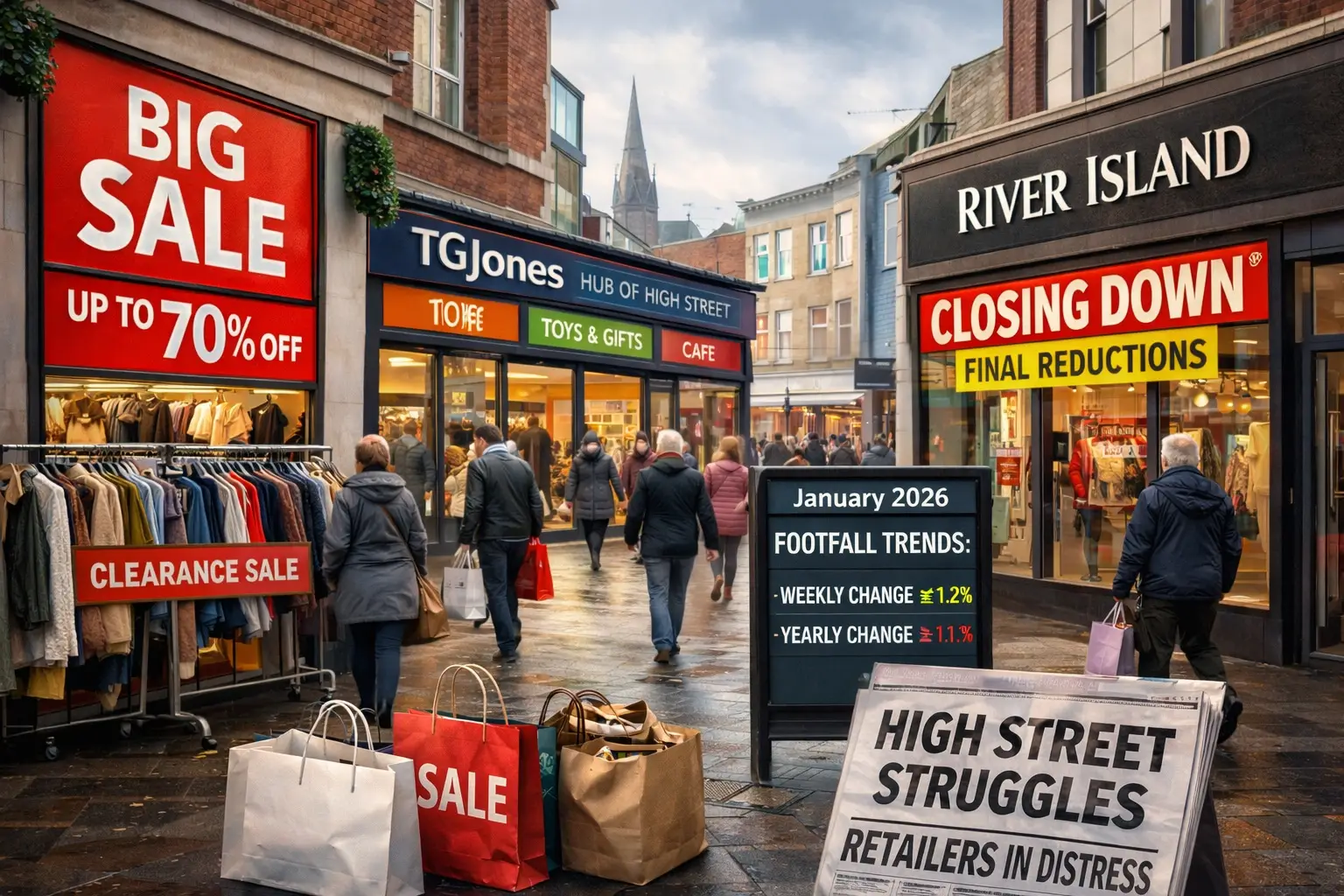
Retail sales rose 2.7% year-on-year, driven mainly by food (+3.8%), while non-food grew modestly (+1.7%) and appeared promotion-led. Footfall improved week-to-week late in the month but stayed down year-on-year, and MRI data framed January as a seasonal drop after December with around a -1.1% annual dip. Restructuring remained a theme, with chains like River Island implementing closure plans, while “hub” models (services + concessions) continued to gain attention.
January is always the high street’s reality check:
Christmas is gone, households are staring at card bills, and retailers either clear stock with brutal markdowns or try to hold price and protect margin. This year, the month landed with a familiar mix of discounting-led spending, soft footfall, and more “reshape the estate” news as chains continue to re-size for a world where online is permanent and town centres have to compete on experience, convenience, and value.
The big headline: sales rose, but the mood stayed cautious
On paper, January trading was fine. UK total retail sales rose 2.7% year-on-year across the month, according to the BRC-KPMG Retail Sales Monitor commentary. Food did the heavy lifting (+3.8%), while non-food rose a more modest (+1.7%)—helped by heavy promotions rather than a sudden surge of consumer confidence.
That split matters. It suggests shoppers were still willing to spend, but prioritising essentials and “deal logic”: buy when it’s discounted, delay when it’s not. It also fits the common pattern we’ve seen for a while—retailers can still generate demand, but often by trading price for volume.
Footfall: “not collapsing” isn’t the same as “healthy”
If sales were supported by promos, footfall painted the more cautious picture. The Office for National Statistics’ real-time indicators showed that total UK retail footfall rose week-on-week in late January, but was down year-on-year compared with the same week in 2025 (using BT Active Intelligence data).
Meanwhile, MRI Software’s January read-out framed the month as a seasonal reset after December’s peak, with footfall down month-on-month and around -1.1% year-on-year overall.
Taken together, that’s a pretty “January” story: fewer browsing trips, more targeted missions. People still come out—just with less tolerance for wandering a tired parade of the same units and more demand for either (a) sharp pricing, or (b) a reason to be there.
Stores, estates, and the continuing “right-sizing” cycle
January also brought fresh reminders that the high street’s recovery is still uneven. A key moment hanging over the month was the reality of previously-announced restructuring plans finally biting.
River Island was the clearest example: its court-approved restructuring plan—designed to cut costs through store closures and rent reductions—was heading into its implementation window, with closures scheduled by the end of January 2026 as part of the wider rescue package.
Whether you see these plans as “saving jobs” or “managed retreat,” the practical high-street effect is the same: more churn in units, more relocation into stronger centres, and more pressure on landlords to be flexible on rent, lease length, and capex.
And it’s not just one chain. Commentary around retail distress has continued into early 2026, with reporting pointing to a rising number of retailers in critical financial distress—a backdrop that helps explain why so many businesses now treat store estates as adjustable rather than permanent.
The “high street hub” strategy gains ground
While closures dominate headlines, there’s also a quieter trend that’s genuinely interesting: the push to make stores multi-purpose again.
The ongoing reconfiguration of the former WHSmith high street estate into TGJones has fed the idea of a “hub” model—stores that combine multiple services and concession-style partners to drive repeat visits. You can see the logic: if people won’t visit for just stationery or magazines, give them reasons to visit for Post Office services, craft, toys, gifting, and other footfall engines under one roof.
This matters because it’s one of the few strategies that tackles the high street’s core problem head-on: frequency. If a unit can become a weekly errands destination, not a once-a-quarter browse, it has a chance.
Promotions got louder—and that changed the shape of demand
Retailers leaned hard into markdowns this January. That helped shift stock, but it also trained behaviour: shoppers learn quickly, and once they expect deals, full-price windows get shorter.
The BRC’s January commentary explicitly linked performance to discounting’s ability to tempt shoppers back after a softer December.
You could feel that on the ground: the month rewarded retailers that were either clearly-value-led (simple pricing stories) or clearly differentiated (product you can’t easily substitute, or an in-store experience you can’t replicate online). The middle—generic product at non-compelling prices—remains the danger zone.
What January suggests for the rest of 2026
January didn’t deliver a single dramatic pivot. Instead, it reinforced the direction of travel:
The high street is stabilising in places—but only where it adapts. Sales can grow while footfall stays soft if shoppers are deal-driven and mission-led.
Estate “right-sizing” is now a normal operating rhythm. Plans like River Island’s show how cost bases are being forced down to match new shopping patterns.
Hubs and mixed-use retail are one of the clearest “positive” plays. More services and complementary concessions can rebuild frequency.
The consumer is present, but selective. The spend is there—especially in food—but non-food growth looks more promotion-powered than confidence-powered.
If you’re watching the UK high street as a bellwether, January 2026 essentially said: the patient is awake, but still on a strict diet. Retailers that can offer value, convenience, or genuine reasons to visit will keep finding oxygen. The rest will keep shrinking footprints, negotiating harder with landlords, or exiting altogether.
TAGS
UK high street, retail, January 2026, retail sales, footfall, BRC, ONS, store closures, retail restructuring, River Island, promotions, discounting, town centres, shopping centres, retail parks, consumer spending, cost pressures, business rates, insolvencies, TGJones, WHSmith rebrand, high street regeneration, bricks and mortar, omnichannel, UK economy